Adjustable Gaming Keyboard Stands: Comfort Without Overpaying
20th Apr•10 min read
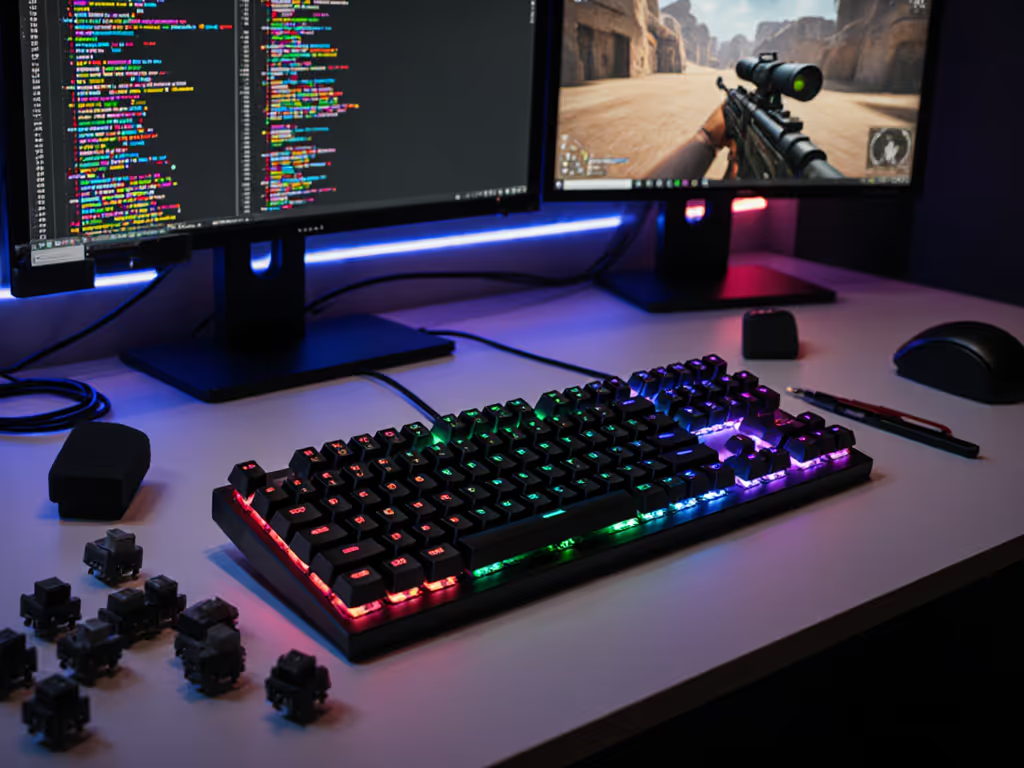
The gap between what a gamer needs and what a programmer needs in a gaming PC keyboard sits exactly where speed meets precision, and where the markup multiplies. You need the sub-millisecond response time of a gaming board, the reliable macro layers of a productivity beast, and the ergonomics to survive an 8-hour coding sprint without your pinky staging a revolt. The catch: most vendors price these demands separately, stacking $100+ markup on every category cross. That's where ROI thinking cuts through the noise.
I've spent the last few years tracking price cycles and testing build stacks that prove a simple truth: smarter spending beats bigger spending. At a weekend LAN, I brought a sub-$100 build with nothing fancy (just plate tape, case foam, and sensible linears), and it sat next to a $250 flexy custom. Our timers and sound meters favored the cheap rig. Friends asked for the parts list; I spent the savings on a pad and practice server time. The lesson stuck: measurable gains per dollar matter far more than the decals on the box. Pay for deltas, not decals.
This article ranks the keyboard categories, features, and tuning strategies that actually move the needle for hybrid gamer-coders, sorted by where your dollar does the most work. If you're tired of spec-sheet noise and want transparent guidance on layout trade-offs, macro reliability, and latency you can feel, read on.
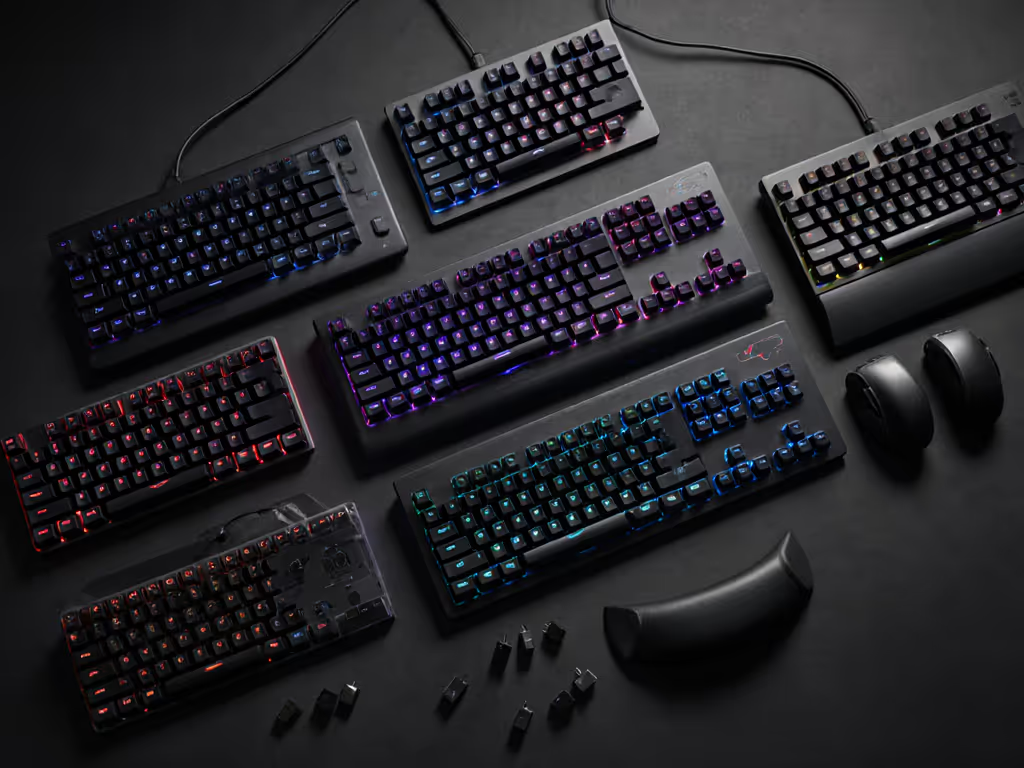
Before switches, before stabilizers, layout is the ROI anchor. Gaming demands peak speed; coding demands frequent reach to the numpad, arrow keys, and function row. A 60% board saves desk space and feels snappier for competitive FPS, but forces you to layer-hunt for the brackets and semicolons you type 50 times a day. A full-size solves it but turns your desk into a landing pad.
The real delta sits at 75%-96% compact full-size boards. For a data-backed breakdown of form factors and reaction time, see our layout performance data. These move the numpad left, keep your right hand on the mouse, and fit in a standard desk footprint. For hybrid work, that's the measurable gain: fewer layer presses per coding hour, muscle memory stays intact during context switches, and your fingers don't cramp reaching the edge of the board. The acoustic penalty is minimal if you tune the case; the latency gain is zero; the ergonomic ROI is real.
An keyboard layout standard matters less than you'd think (UK, US, ISO), but consistency with your OS language setting prevents surprise key ghost-mapping during heavy typing. If your day flips between gaming sessions and terminal work, pick the layout your muscle memory already knows. Switching layouts mid-career is a $200 hassle for a zero-performance gain.
Takeaway: A 75-96% compact board returns the highest ROI for hybrid gamer-coders. Choose the layout your OS and fingers already know, and lock in that consistency.
Every vendor claims "unlimited" macros. None mean it the same way. Some boards offer 8 layers of keymap redefinition; others offer 3 layers with a bloated software suite that crashes on beta driver updates. The delta that matters: firmware stability and layer access speed.
A reliable macro system means you can reprogram the entire board over USB without installing driver bloat, and your layers execute the same action every time (no 1-in-500 ghost presses). The best boards offer VIA or QMK support, which means open-source, crowd-tested firmware. You layer three times a day for productivity shortcuts; a 5% failure rate kills focus faster than a 10ms latency bump.
The cost difference between a board with 3 reliable layers and one with 8 flaky layers backed by sketchy software is often $20-40. The ROI is inverted: pick the board with fewer but bulletproof layers. Test them in the vendor's Discord community before buying. Real user reports will tell you if the macro system is solid or a beta trap.
Takeaway: Reliability in macro execution beats layer count. Seek boards with VIA or QMK support, and verify community stability reports before purchase.
Low-profile switches actuate faster (usually 1.2mm travel versus 1.5mm for standard linears) and feel snappier on the first press. For gaming, that's sub-5ms gain per keystroke. For a competitive FPS, that compounds. For coding, the gain is perceptual: you feel faster, which can improve consistency, but the raw throughput ceiling is already hit by your typing speed, not the board.
The catch: low-profile switches fatigue your fingers faster on long sessions. Shorter travel means less tactile feedback; you bottom-out more often; your wrist position drifts without the mechanical anchor point of standard travel. I've seen coders switch to low-profile for rank anxiety, then back off after a month of wrist ache.
The real ROI lives in the middle: mid-profile switches (1.3-1.4mm travel) with a solid low-profile case that doesn't flex. You get 70% of the speed gain, 100% of the ergonomic comfort, and your hand stays stable during an 8-hour sprint. Don't trade rest for reaction time (that's losing math).
Takeaway: Mid-profile switches (1.3-1.4mm) return better ROI than full low-profile for coders. Speed gains plateau; ergonomic penalties don't.
Wireless keyboards offer convenience; they also introduce a new failure vector: connection latency and de-sync during heavy macro sequences. A 2.4GHz wireless board polls at 1000Hz in ideal conditions, which matches a wired board. See our wired vs wireless latency tests for the real-world gap under interference. But "ideal conditions" rarely show up mid-tournament or mid-sprint. Any interference spike, any sleep-wake cycle during a match, and your macro chain hiccups.
The price delta is usually $30-60 more for the same board with wireless. For gaming, that's worth it if you prioritize desk flexibility. For coding, where macros matter more than milliseconds, the delta flips: wired reliability beats wireless convenience. Your keyboard sits on your desk for 8 hours; cable clutter is a non-issue.
Hybrid boards (wired + optional Bluetooth) split the difference. You gain Bluetooth mobility on weekends and keep USB reliability for weekday work. The cost usually sits between pure wired and pure wireless, and the ROI is high if your schedule varies.
Takeaway: For coders, wired reliability outweighs wireless convenience. Hybrid boards offer balanced ROI; pure wireless adds cost for marginal gain.
RGB lighting sells boards. RGB tuning improves focus. Most coders work in dim rooms or overnight sessions; a blinding keyboard turns a productivity tool into a distraction tax.
A solid dark mode keyboard lighting setup means: single-color backlighting (white or amber), no flashing, brightness control down to near-zero. This keeps your eyes adapted to the screen (where your focus actually lives), reduces fatigue on night sprints, and actually costs less to implement than RGB. RGB requires more power, more LEDs, more firmware complexity, and more driver updates. Single-color backlight? Fixed hardware, no bloat.
The ROI argument: if you game and code, you'll customize lighting for both contexts. RGB boards force you to reprogram every session-switch. Boards with simple single-color backlighting stay tuned once and never need touching. Less customization overhead, fewer driver headaches, lower decision fatigue. Pay for what you actually use.
Takeaway: Single-color backlighting with adjustable brightness beats RGB for coders. Lower power draw, stable firmware, no nightly reconfiguration.

Your spacebar, shift, and enter keys don't bottom out evenly; they rattle, and they feel sloppy. That's a stabilizer problem, and 70% of new boards ship with factory stabilizers that aren't tuned. Understand how stabilizer mechanics affect input consistency and noise during competitive play. The fix is simple: a little lubricant, band-aid strips under the stabilizer wire, and 20 minutes of work.
The cost: $0-5. The ROI: eliminating the single biggest ergonomic drag on long typing sessions. A rattly stabilizer makes every spacebar hit feel unreliable; your brain compensates by pressing harder, which fatigues your thumb and wrist. After 8 hours, that adds up to real pain.
Most premium boards charge $50+ more for "pre-tuned stabilizers." The actual tuning is trivial and repeatable. If you're not comfortable opening the board yourself, factor in $15-20 of labor, and the total cost of converting a $100 board into a $125 fully-tuned board beats buying a $250 "premium" board that ships with the same basic stabilizers.
Takeaway: Stabilizer tuning is a high-ROI, low-skill maintenance task. Budget $5-20 for tuning materials and learn the skill; it pays dividends across every board you own.
A hollow plastic case vibrates. A metal case rings. Both are cheap to produce and expensive to tune. The acoustic delta between a $100 hollow board and a $150 tuned board is usually case damping (foam inside the case, on the PCB, under the spacebar). Damping doesn't change latency; it changes your brain's perception of the board's quality and stability.
For coders sharing a room or working late-night, acoustic tuning is practical, not cosmetic. A dampened board is quieter to operate; your roommate doesn't wake at 2 AM; your focus doesn't spike on guilt. The ROI is environmental fit.
Budget tuning ($10-15 in shelf foam) returns most of the acoustic delta. Premium damping (designed foam kits, gasket strips) adds polish but diminishing returns. Start with shelf foam; if your ear asks for more, layer on designed kits. Simple first, fancy later.
Takeaway: Case damping improves acoustics and perceived quality. Budget foam tuning covers most ROI; premium kits offer polish, not power.
ABS plastic caps are cheap and ship on most boards. They shine after 6 months of heavy use, which changes how your fingers engage the surface. PBT caps wear slower and resist shine. The cost delta is $15-30 for a full keycap set.
For a board you'll use 5 years, PBT keycaps return solid ROI: you won't need replacement sets mid-career, and your hand position stays consistent across years. For a board you'll swap out after 2 years, ABS is fine; the wear doesn't matter.
The real ROI: double-shot or dye-sublimated legends don't fade; single-shot legends do. If you use standard legends only (no custom icons), the risk is lower. If you're a visual learner who leans on custom keycap legends, invest in a set with durable printing.
Takeaway: PBT keycaps with durable legend printing reduce long-term replacement costs. For a 5+ year board, the $20 premium is ROI-positive.
Boards that ship updates weekly are often fixing bugs instead of preventing them. Boards with stable firmware that update quarterly mean the vendor shipped a solid product. Community support (Discord servers, firmware documentation, troubleshooting threads) tells you how much friction you'll hit when something breaks or you want to customize.
A board with sparse community support forces you to DIY fixes or contact a vendor with slow response. We track brand ecosystems in our update reliability analysis, including stability and performance impact. A board with active community means you troubleshoot in real-time and learn from shared solutions.
The ROI: reduced downtime and faster problem-solving. Worth 20-30% of your purchase decision.
Takeaway: Seek boards with stable firmware and active community support. Frequent updates often signal QC problems; stable releases signal confidence.
A hotswap board lets you swap switches without soldering. A board with standard hotswap sockets (MX or compatible) means you can source replacement switches from dozens of vendors for years. A proprietary socket means the vendor controls your parts supply, and discontinuation kills repairability.
For a coder with a 5+ year board lifespan, hotswap + standard sockets = future-proof. You experiment with new switch feels without committing; you repair dead switches for $3 instead of buying a new board; you adapt the board as your hand strength or preferences change.
Non-hotswap boards are cheaper upfront but lock you into one switch type and require soldering to change. Unless you're buying a throwaway board, hotswap returns real ROI.
Takeaway: Hotswap with standard socket compatibility future-proofs your board. The $30-50 upfront premium amortizes across years of repair and experimentation.
A gaming PC keyboard for coders lives in a trade-off space between speed, reliability, and ergonomics (and between the price you want to pay and the price vendors want to take). The highest ROI doesn't come from buying the most expensive board; it comes from understanding where you actually spend your time.
Pick a 75-96% layout that matches your coding habits. Seek reliable macro support with minimal software bloat. Tune your stabilizers and case damping on a budget. Stick with wired if macros matter, or hybrid if portability does. Invest in PBT keycaps and durable legends if you're keeping the board long-term. Verify community support and firmware stability before committing.
These trade-offs don't require spending $300. A $120-150 board with sensible switch choices, stable firmware, and $20 in tuning materials will outperform a $280 boutique board that ships with rattly stabilizers and no community support. I've lived it, and so have the coders in my community who've tested the ROI math themselves.
The verdict: prioritize measurable performance (latency, macro reliability, ergonomic fit) over hype. Seek boards with clear upgrade paths and honest specs. Spend where it scores; skip where it sparkles. Your wrist and your wallet will thank you.